
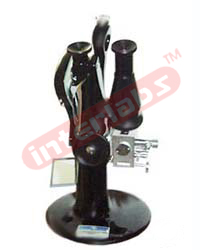

For the examination of liquids open the prism box and place a few drops upon the ground surface of the lower prism. Close and fasten the prism box when the liquid will be squeezed into a thin film between the prism. Focus the crosswire with the eyepiece, adjust the mirror until the illumination is good, and gently turn the prism box by means of a milled head screw forwards and backwards until a coloured band appears in he field of view. By turning the milled ring at the base of the telescope, a position will be found at which the coloured band will be eliminated, the field of view being partly light and partly dark with a sharp dividing line. Bring this sharp dividing line into coincidence with the intersection of the crosswires and read the refractive index or sugar percentage on the divided arc by means of the magnifier.
The scale is divided to the third decimal place, the fourth being easily oriented by estimation. It will be noted that the hing of the prism box is so constructed that the lower prism in the box may be removed. For the examination of plastic bodies such as resin, remove the lower prism box, soften the material by heat, and smear a little on the exposed surface of the upper prism, then proced as above. To examine crystals or glasses. A specimen should be prepared, similar in shape to the standard glass test piece provided. Moisten the polished surface of the specimen with the smallest possible quantity of monobromonapthalene and place it upon the suface of the prism with the ground edge directed towards the mirror. Care must be taken to avoid excess of monobromonathalne as this may spoil the definition and confuse the reading. When the correct quantity is used, the specimen will adhere firmly to the prism face.The instrument is sent out carefully adjusted, but it is as well to verify the setting by applying the class test piece to the prism and nothing if the reading is that marked on the piece. I this is not the case, adjust the small squared screw at the back of the telescope with the key provided until agreement is secured. The mean of several reading should be taken if great accuracy is desired.
Abbe Type Refrectometer for Institutional & Laboratory Applications
Abbe Type Refrectometer is designed for educational institutions, research centers, universities, and laboratory facilities. Interlabs manufactures export-quality educational laboratory equipment for institutional procurement projects, technical education programs, laboratory modernization, and international supply requirements across Kenya, Nigeria, South Africa, and Ghana.
Applications of Abbe Type Refrectometer
This equipment is widely used for practical learning, institutional research, technical demonstrations, and laboratory education. It supports practical learning environments, institutional laboratory setups, technical training programs, and advanced educational applications.
Suitable For
- Universities and educational institutions
- Research laboratories and training centers
- Government and institutional procurement projects
- African laboratory infrastructure programs
- Technical and vocational education facilities
Explore Related Laboratory Equipment
Interlabs also supplies Advanced Communication Trainers, Data Communication Trainers, Autoclaves for educational institutions, engineering laboratories, research centers, hospitals, and export projects.
Why Choose Interlabs?
- Educational laboratory equipment manufacturer and exporter
- OEM and custom manufacturing support available
- Export-ready packaging and documentation assistance
- Suitable for institutional and government projects
- Global shipping and bulk supply capability
Global Export Support
Interlabs supplies laboratory equipment and institutional training systems to buyers across Kenya, Nigeria, South Africa, and Ghana with secure export packaging, documentation support, and international logistics assistance.